

To Consider This Land
By Gabrielle Mitchell-Bonds


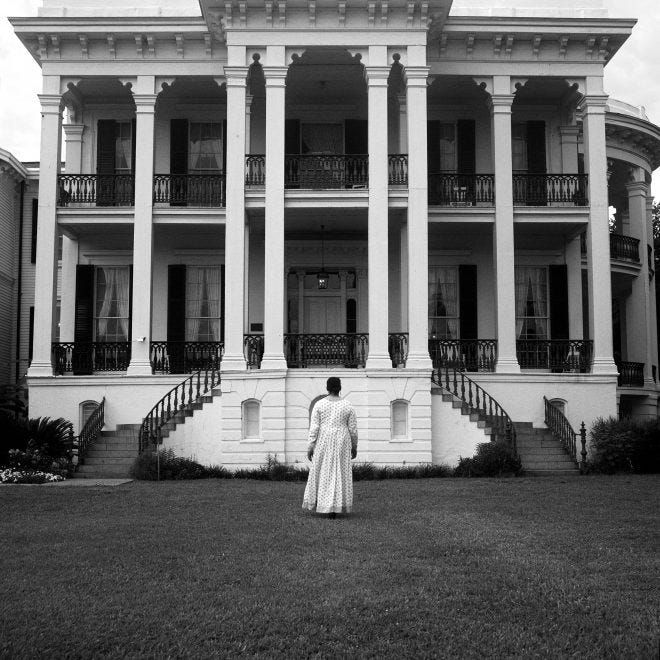
Carrie Mae Weems, At the Precipice, 2003. Gelatin silver print. Courtesy the artist and Jack Shainman Gallery, New York.
“The land is the only thing in the world worth working for, worth fighting for, worth dying for, because it’s the only thing that lasts.” – Gerald O’Hara, Gone With the Wind (1939)
When white Americans are drawn to former plantations as sites of historical charm, they do not come to see the headstones of hundreds of enslaved African Americans who were physically, sexually, and mentally exploited, or the remnants of a brutal racial struggle amidst the United States’ flourishing. They come for the picturesque countryside, the romantic vistas of the Southern landscape, and the “Big House” itself. However, the “Big House” dominates the attraction of the Antebellum era as a Confederate dream remembered. The popularity of recreational events hosted on former plantations lays bare their haunting appeal. While white Southerners adore the Southern aesthetic, the history of the South goes far beyond its physical beauty and deeper into what the South symbolized during American slavery. How much of this regional romance lends itself to a vantage point including the lives, lineage, and labor of enslaved African Americans? At what point will we look beyond the white columns, oak trees, and magnolia flowers and into an ethos of remembrance—of the African American pain that this country was and continues to be—built upon?
In 2003, photographer Carrie Mae Weems completed her series The Louisiana Project commissioned by Tulane University’s Newcomb Art Gallery as part of their bicentennial commemoration of the 1803 Louisiana Purchase. In this transaction with the French First Republic, the United States purchased about 530,000,000 acres of territory. With over seventy photographs, Weems uses her body as a medium to travel through physical and metaphorical landscapes of Southern history and Louisiana’s ghost-like relationship with enslavement and African American violence. Weems identifies architecture as a critical component in shaping an African American cultural identity and places herself before the Malus Beauregard House, built on the ruins of the former Chalmette plantation and battlefield. Built in the early 1830s, the house is named for René Beauregard, its last owner, the son of the Civil War Confederate General Pierre Gustave Toutant (P. G. T.) Beauregard. The Chalmette Battlefield grounds marked the 1815 Battle of New Orleans, which solidified the United States’ claim to the Louisiana territory. The house is a prime example of a Louisiana-style plantation house of the Antebellum era, visually reproducing part of a cultural identity rooted in the subjugation of African Americans.
Though Weems’s entire series highlights a witness to this collective trauma, one photograph displays a certain longing; a quiet contemplation of the plantation itself and Weems’s complicated presence on its grounds. A Distant View (2003) features Weems lying on the lawn of the former plantation. The Malus-Beauregard House sits in the background, embodying the ‘distant view’ of the piece’s title. Weems foregrounds the photograph, but the plantation house towers over her figure. With her back fully turned away from the viewer, she sprawls on the grass under the shade of tall trees. Though her face is obscured, the way she sits with her knees bent and legs to the side softens the scene. Her hands rest gently by her body, and her head is slightly cocked to one side. The large distance between Weems and the plantation suggests a sort of longing, or, better yet, space for pondering. Her presence on the plantation symbolizes a direct convergence of past and present.
Weems’s assertive pose is as much of a reflection as it is an accusation: she effectively confronts the mystique of the building with her gaze, extracting the brutal history adorning her and her ancestors. What does it mean for an African American woman to look this plantation in the eye after it has been redesigned as a place of allure? What does it mean for this building, a concrete picture of white power, to be confronted with Weems and the corporeal trauma of her and her lineage?
The representation of Weems’s body is a physical manifestation of African Americans’ inability to look away from the United States’ incriminating racial realities. She places her body—and in fact, rests—against the tangible evidence of slavery’s remains. While the plantation has outlived the specific era of American slavery, it stands tall in the present day, face-to-face with Weems and wholly indicative of slavery’s legacies. The viewer and the artist’s visibly identifiable identity is integral here, altering the implications of sight itself. With Weems as the viewer, we consider the racial implications of the plantation, but also the unique experiences of enslaved African American women. In certain Southern states, “law[s] categoriz[ed] African women as ‘tithable’ labor,” depriving them of the right to express both their femininity and general personhood.1 Here, African American women were inextricably linked to racial capitalism, but they were also subject to sexual exploitation from their white slaveholders. African American women were treated as disposable, both legally and culturally, and were subject to ceaseless violence and hard labor. The presence of an African American woman on this plantation is both devastating and powerful as Weems situates herself within a history predicated on gender and race-based subjugation while simultaneously defying it.
Guided by Weems, the viewer is meant to confront the encompassing chronicle of the plantation in its aesthetic, its history, and its unspoken horrors, as she does the same. Weems reveals what is unseen in the plantation’s history, beneath the subterfuge of Southern romance. The “Big House” narrative itself is insidious, a distant dream to simultaneously avoid and celebrate the ideology that used slavery to achieve the victory of the plantation. We reify the plantation legacy through casual tourism, recreation, and passive viewership.
Weems challenges this racial battleground and its problematic show of grandeur and elegance wrapped tightly in the beautiful facade of the brutal South. As Williams puts it, “No matter their innocence, the symbols summon pain.”2 Though white Americans can isolate American visual culture from its less than aesthetically pleasing, less than ‘innocent’ context, the truth remains. The plight of enslaved African Americans is hardly at the front of their gaze, nor their memory. The overwhelming number of White visitors who continue to casually paper over the plantation as a place of collective trauma and help make mainstream the plantation as a perfect venue, the place to commemorate a monumental event.
Williams explains that the antebellum in the fantastical sense is an accessory to romance in which white Southerners visiting former plantations are “‘Dancing on graves!’” without remorse.3 White visitors attempting to celebrate Southern heritage on former plantations embody the dream of a white master, his white household, his white family, and his white power. These visitors are then able to control the plantation, erasing and rewriting history to idolize the master and forget the enslaved. With this in mind, how can the extravagance of a plantation, with its overbearing height and splendor, not hold the underbelly of Southern pride and romance behind its louvered doors, making it a modern orifice of wealth and power?
The deliberate staging of extravagant plantation events fetishizes the unpaid labor that made them possible. Slavery denoted the Black body as a form of disposable currency, a means to build up the South and its veneer of glamor. This attractive façade is most notably present in Margaret Mitchell’s 1936 novel Gone with the Wind and its 1939 film adaptation, which Williams highlights in her book. The strategic concealing of the reality of slavery under the guise of Southern nostalgia is undeniable, as Mitchell writes about slavery as a benign necessity to Southern life. The novel and the fantastical world it presents build up white planter authority over African Americans, representing a much more realistic African American history as shaped by the gruesome institution of slavery. The boom of the “Big House” and the prosperous master cannot be separated from the unpaid, exploited labor of African Americans that brought us to this point, which still fortifies American racial capitalism. White visitors to former plantations assert a capital—uniquely social, racial, and economic—that deliberately obscures the stories of African Americans who made the plantation possible. This act of historical blindness, the luxury of superficial engagement, is not a privilege granted to Weems and Williams. The context of their unavoidable realities taints American ground, even beyond the South.
In New York, one of the last Northern states to abolish slavery, photographer Nona Faustine gives this notion of plantation romance a regional twist in her series White Shoes. The series is a collection of more than 40 self-portraits in which Faustine uses her body to interrogate: What does a Black body look like today in the place where they sold human beings 250 years ago? Posing in sites across New York City, such as Harlem, Wall Street, Prospect Park, Lefferts Historic House, she addresses these locations as former sites of slave auctions, burial grounds, slave-owning farms—the physical legacy of enslavement up North. On her feet are a pair of white pumps, allowing her to traverse endless lands that hold years of both death and survival of her Black ancestors. The heels evoke notions of femininity, literal whiteness, and class, nodding to systems of white heteropatriarchy continuously used to justify racial hierarchy. Her attire ranges from stark nudity, partial modesty, or even comprehensive historical outfits. She takes a stance of solidarity with ancestors whose bodies fertilize the ground beneath her white shoes.
As Faustine confronts the obscured history of slavery in the North, she places herself in direct conversation with Weems through her piece, There are few markers left but your black body is the marker. The land does hold the memory of your existence. You only have to put it there in its natural state to remember. – Harriet Tubman (2021). Faustine occupies the same languid stillness as Weems, lying with her knees bent and legs to the side, her white pumps barely peeking out underneath her long white dress. She dons a suede tan hat with her held high before a manor in the distance. In this scene, Faustine’s body is in physical opposition with Shelter Island, New York’s version of the Sylvester Manor: a 240-acre historic plantation and the most intact remnant of a former slaveholding plantation north of Virginia. Home to eleven generations of Sylvester Descendants, African men and women kidnapped from the continent were held in bondage at the Manor from 1651 to 1820 and were responsible for the “cultivation of the land, building, and maintaining of the property.”4
Weems and Faustine use their bodies as central elements to challenge the historical erasure embedded in plantations, both Southern and Northern. By placing themselves on these sites of slavery, they confront the abhorrent past obscured by Southern romanticism or Northern amnesia. Weems’s poised reflection before the Malus-Beauregard House and Faustine’s presence in Sylvester Manor claim the landscapes as archives of African American resilience and loss. Through these embodied acts, both artists transform the land into a vessel for remembrance, asserting African American identity within spaces tainted by historical violence. Their work transforms plantations from romanticized sites into confrontational spaces of historical reckoning and remembrance. Their Black womanhood is a bridge between past and present, reshaping what it means to walk Northern and Southern lands that thrive in the present, but are built on generations of Black death.
Just as Weems sat solemnly in the foreground of the Malus-Beauregard House lawn, Faustine gazes at the manor from afar in both defiance and reflection. What differentiates the two photographs now is geography: a push-and-pull between Northern and Southern dynamics of slavery. New York City was a critical port in the Transatlantic Slave Trade, and ‘free’ Black people in the city continued to face violence, segregation, and surveillance under threats to be sold back into slavery in the South.5
In Faustine’s photograph, the plantation is shrouded by multicolored foliage, but it does not hide behind the romance and myth of the “Big House” in the South, nor does it hide behind the aesthetics of New York’s skyscrapers and busy streets. Instead, it is intentionally unseen under the guise of Northern benevolence and willful historical silencing. Faustine’s body is central both compositionally and symbolically: her self-described “fat, Black, naked, female body on display” further transforms the land.6 She uses her own body in this photograph, as well as her collection as a whole, to acknowledge how Black female bodies become canvases for Western racial and sexual anxieties. Yet, she reclaims the legacy of Black womanhood as a symbol of resistance against imposed narratives of dehumanization and fetishization. As articulated in the photograph’s title, Faustine’s Black female body is a marker of witness on the land. The vibrant photograph is an immediate engagement with the history of African Americans’ lives cruelly dictated by our country’s racism. Faustine urges us further to think critically about the many more nameless, faceless ghosts of the past in the places we call home.
The plantation is owned, operated, and dominated by white male narratives, both physically and culturally. The lavish mansions and estates have always been for a white master in celebration of his esteemed wealth and property, whether it be the land itself or the people. The white master retains ownership of both these legacies. Slavery presented a sexual economy in which white masters had legal control over the offspring of Black women, and therefore, control over the potential of their labor. The law partus sequitur ventrem indicated that “the offspring follows the mother in her condition of slave or free, [. . .] which gave priority to the rights of slave-owners above the familial rights of slaves.”7 The power of white masters to effectively elongate or abridge African American ancestry of their own accord led to a “[legal] kinlessness” in which African Americans had no recognition in the family and could not pass on an inheritance to their descendants.8 White masters held authority over African American histories and futures, with the decisive power to silence an entire lineage. In their work, Weems and Faustine enliven the futurity of this lineage by challenging the hegemonic power of the master over the bodies of those enslaved. By positioning themselves before sites and institutions of conquest, both women use their bodies to supplant the incomplete, lasting narratives we propagate of the plantation. Challenging historical amnesia, Weems and Faustine situate the Black female body as central to the land, and the land as central to how we remember slavery. Amidst a gross sanitizing of history, these artists ensure that they will not be erased; they shall not be moved.
To see the underpinnings of plantation romance, we must open our eyes to the violent subterfuge of the places, traditions, and people that forget African Americans, rewriting Black bodies out of sight and out of mind. With their bodies on these contested landscapes, Weems and Faustine transform sites of racial violence into spaces of embodied resistance. Their presence unsettles the illusion of Southern charm and Northern innocence, forcing the viewer to reckon with the physical and psychic scars that linger in the soil. Here, these histories are not abstractions, but felt, lived, and carried within the Black body. The Black body itself, free and alive, is evidence enough.
Faustine, who passed on March 20, 2025, leaves us with a question she once wondered about her own neighborhood: Will I be remembered? Will I be here?9 In the face of land that has so often swallowed the stories of Black life whole, her question feels both intimate and enormous. This essay, like the work it engages, answers softly but firmly: yes. Yes, in the images where her body testified. Yes, in the neighborhoods of New York that she loved. Yes, in the ground itself. And yes, in the labor of all who look closely and refuse to forget. In the tenderness of her repose and the strength of her vision, Faustine remains. She is remembered. She is here.
Against the plantation’s quiet violence, Weems and Faustine leave us not only with grief but a mandate to remember, to resist, and to carry forward. They look back at the plantation, responding to its deafening silence to create a visual grammar centering Blackness in space and time, and offering their own bodies atop history. No longer are the legacies of enslaved African Americans spectral or forgotten. Weems and Faustine anchor Black life in the present, offering an aesthetic intervention that centers remembrance, testimony, and survival. In stillness, these artists demand that the viewer sit with the weight of the narratives that endure. In doing so, they allow the Black body—surviving, living, and lasting—to lay claim to the land itself.
Notes
Tera W. Hunter, Bound in Wedlock : Slave and Free Black Marriage in the Nineteenth Century, 2017, Cambridge: Harvard University Press, 64.
Patricia J. Williams, Giving a Damn : Race, Romance and Gone with the Wind, 2021, London: TLS, 15.
Ibid, 1.
Sylvester Manor. https://www.sylvestermanor.org/.
“The Transatlantic Slave Trade.” Equal Justice Initiative. https://eji.org/report/transatlantic-slave-trade/origins/#the-european-influence-on-africa.
Qiana Mestrich. Dodge & Burn. November 4, 2014. https://dodgeburnphoto.com/2014/11/photographer-interview-nona-faustine/.
Hunter, 65.
Ibid.
Nona Faustine, “Pt. 4 | The Photographer | Antwaun Sargent + Nona Faustine,” 2019, in Between Two Palms, 00:03:19,
 | A guest post by
|
This is excellent scholarship! It could be an entire workshop, lecture series, course, etc. I paused several times while reading to just sit with passages. I will be rereading and sharing. Brilliant!🤎👏🏿👏🏿👏🏿✨
Good read 👏🏽